
The Jewish Section inside Milan’s Monumental Cemetery is a place of burial, memory, art and community history. This guide covers the Riparto Ebraico within the Monumentale, not the separate Jewish cemetery at Cimitero Maggiore. Opened in 1872 and expanded during the twentieth century, it preserves simple graves, family chapels, major works of sculpture and a memorial to Jewish people who died during the Second World War.
A visit offers a different perspective on the Monumentale and on the role of Jewish families in Milan’s cultural, financial and civic life. It should always be approached as an active sacred space, with particular care for graves, ceremonies and personal memorials.
Jewish Section: quick answers
Does Milan’s Monumental Cemetery have a Jewish Section?
Yes. The Riparto Ebraico is located on the eastern side of the Monumental Cemetery and has been in use since 1872.
How long does the official route take?
The complete official itinerary includes 10 monuments and takes approximately 40 minutes. A shorter five-stop option takes about 20 minutes.
What visitor etiquette should be followed?
Treat the area as an active sacred cemetery. Keep voices low, remain on the paths, do not disturb ceremonies and never move stones or memorial objects placed on graves.
Jewish Section: essential information
- Italian name: Riparto Ebraico, historically also called Riparto Israeliti.
- Opened: 1872.
- Location: on the eastern side of the Monumental Cemetery.
- Official itinerary: 10 monuments, approximately 40 minutes.
- Short official option: 5 monuments, approximately 20 minutes.
- What you will find: ground burials, family chapels, symbolic sculpture, Jewish decorative motifs, the Ceremony Hall and a post-war memorial.
History of the Jewish Section
The section opened in 1872, replacing the Jewish burial grounds at Porta Tenaglia, Porta Magenta and Porta Vercellina. Its present area reflects later extensions completed in 1913 and during the 1920s.
The section forms part of the wider Monumental Cemetery conceived by architect Carlo Maciachini. Its position on the eastern side created a distinct burial area while placing it within the larger civic cemetery, opposite the non-Catholic section on the western side.
A place of life, memory and teaching
In Jewish tradition a cemetery may be called beth ha-chajim, the house of the living. The expression reflects the continuing relationship between the living and the dead through memory, teaching and mourning.
One distinctive feature of this section is the presence of common grassy fields with simple, similar gravestones placed directly in the ground. Visitors may also notice small stones resting on graves. In Jewish custom, placing a stone can express remembrance and continuity. These stones are personal memorial gestures and must never be removed or rearranged.
Art, architecture and Jewish symbols
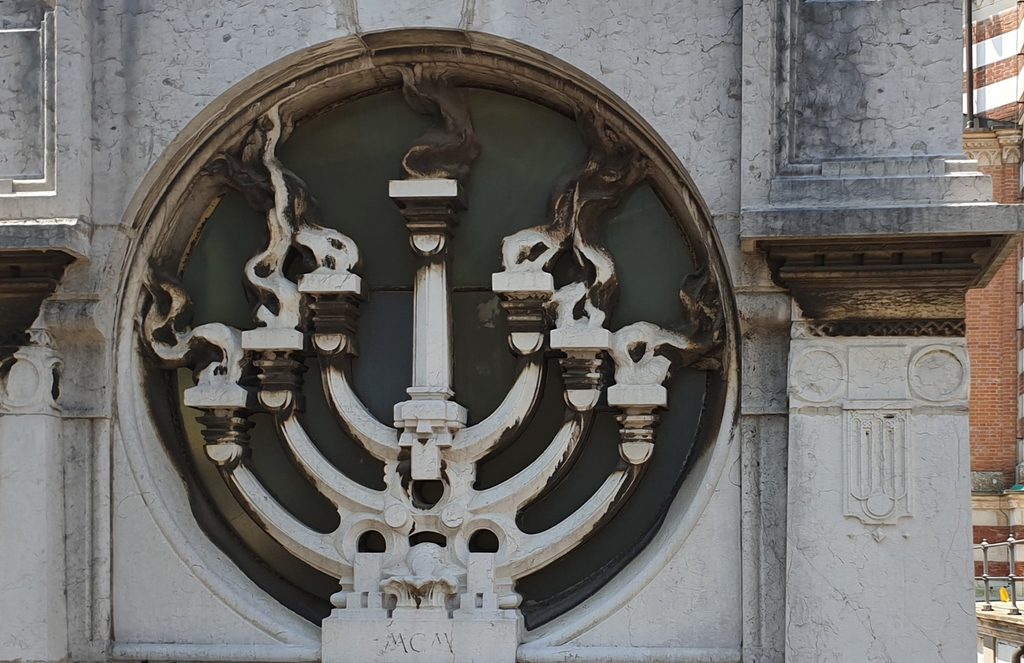
The family chapels and monuments span different periods and styles. Some use a delicate Liberty language, while others incorporate symbols including the menorah, the seven-branched lampstand, the Star of David and the Solomon’s knot.
The section also records the presence of prominent Milanese families and individuals, including the publisher Treves, the Pisa, Vitali and Finzi banking families, and Giuseppe Levi, founder of charitable night shelters bearing his name.
The Ceremony Hall
Near the centre of the section stands the Ceremony Hall. Maciachini originally designed the pavilion as an entrance building, mirroring the structure associated with the non-Catholic section. It is now used by Milan’s Jewish community for religious and funeral ceremonies.
The artistic stained-glass windows by Milanese artist Diego Ardemagni revisit imagery associated with Marc Chagall and represent the Twelve Tribes of Israel, whose names appear above the windows. Inside are an altar thought to date from around 1920 and a ceremonial chair created by sculptor Mario Quadrelli in 1897.
The official 10-stop itinerary
The Municipality of Milan’s official route takes approximately 40 minutes. The locations below use the cemetery’s field and space numbering.
1. Monumento Finzi
Location: Jewish Section, Field 1, space 7. Sculptor: Rizzardo Galli. Date: 1889. The official itinerary introduces this evocative monument as a representation of the resurrection of the flesh in the vision of the prophet Ezekiel.
2. Monumento De Daninos
Location: Jewish Section, Field 1, space 4. Sculptor: Enrico Cassi. Date: 1906.
3. Monument to the Jews Who Died During the War
Location: new extension, spaces 16, 17, 17a and 18. Architect: Manfredo D’Urbino. Date: 1947. This memorial honours Jewish victims of wartime persecution and presents their suffering as a lasting call for justice, freedom and human fraternity.
4. Monumento Misrachi
Location: Jewish Section, Field 6, spaces 66 to 67. Sculptor: Mario Bergamaschi. Date: 1933.
5. Monumento Levi
Location: Jewish Section, Field 2, space 121. Sculptor: Egidio Boninsegna. Date: 1910.
6. Edicola Giuseppe Treves
Location: Jewish Section, Field 2, garden spaces 141 to 142. Architect: Augusto Guidini. Sculptor: Ettore Ximenes. Date: 1906.
7. Monumento Norsa
Location: Jewish Section, Field 2, spaces 14a, 15b and 16a. Sculptor: Giulio Branca. Date: 1881.
8. Edicola Vitali
Location: Jewish Section, Field 1, space 16. Architect: Giovanni Ceruti. Date: 1886.
9. Edicola Segre
Location: Jewish Section, Field 1, spaces 14 to 15. Architect: Luigi Conconi. Date: 1898.
10. Edicola Pisa
Location: Jewish Section, Field 1, spaces 9 to 10. Architect: Carlo Maciachini. Date: 1885.
The 1947 memorial
The Monument to the Jews Who Died During the War is one of the section’s most important places of collective remembrance. Designed by Manfredo D’Urbino and inaugurated in 1947, it commemorates victims of persecution and war, including those connected with the Shoah and the Resistance.
Pause here without treating the memorial as an ordinary sightseeing stop. Read the inscriptions quietly, allow space for other visitors and avoid staged or intrusive photographs.
How to find the Jewish Section
The Jewish Section is on the eastern side of the cemetery. From the main entrance, keep towards the right-hand side and follow signs for the Riparto Ebraico or Riparto Israeliti. Ask the Infopoint to indicate the current access route, especially if a ceremony or maintenance work affects normal circulation.
Visitor etiquette
- Remember that this is an active Jewish cemetery, not only a collection of historic monuments.
- Keep voices low and give funerals, religious ceremonies and mourners complete privacy.
- Do not touch graves, inscriptions, memorial objects or stones placed by families and visitors.
- Remain on designated paths and respect gates, barriers and temporary closures.
- Use respectful clothing and behaviour.
- Do not photograph identifiable visitors, ceremonies or close personal details without consent.
- Professional and organised photography requires advance authorisation.
Planning your visit
- Allow about 40 minutes for the complete official route.
- Collect a cemetery map or save the official itinerary before entering the section.
- Expect gravel and uneven surfaces in some areas.
- Check the opening hours and last admission.
- Read the site’s visitor rules and photography guidance.
- For mobility information, consult the accessibility guide.
Official source and last check
The history, traditions, route, locations, attributions and dates were checked in October 2026 against the Municipality of Milan’s official Jewish Section itinerary. This is an independent visitor guide, not the official cemetery administration.
Researched and written by Giovanni Passaro. Information checked against official Municipality of Milan sources in October 2026.